
The Indianmeal moth is often described as the most common of pantry parasites in North America. This small, nocturnal butterfly can quickly infest dried food products, because that’s where it lays its eggs.
In this guide, you’ll discover how to recognize an Indianmeal moth infestation and which methods to use to eliminate them.
Do you suspect your pantry might be infested? Contact AJS Extermination, your pest control specialist on the South Shore.
What does the Indianmeal moth look like?
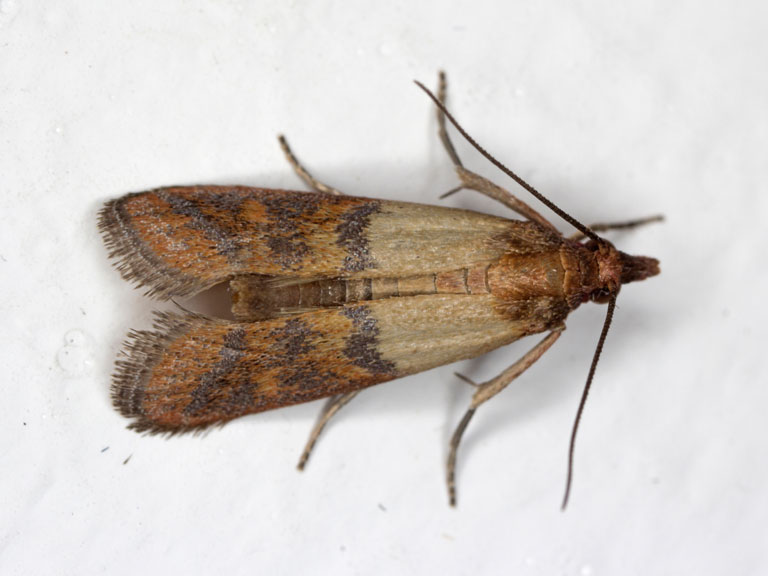
A small, discreet and nocturnal butterfly, the Indianmeal moth (Plodia interpunctella) is about 1 cm (0.5 in.) long. Its wings have two colours: light grey near the body, but reddish brown, sometimes copper, at the ends. At rest, its wings form an elongated triangle.
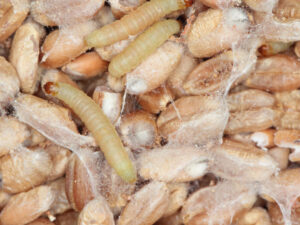
The main problem, however, arises from the Indianmeal moth’s larvae. They are tiny caterpillars only 10 mm to 13 mm long. They are cream-coloured with a brownish head, and can be confused with a small worm.
Indianmeal moth or mite? What’s the difference?
The Indianmeal moth is sometimes confused with other kinds of mites, such as the clothes moth. The clothes moth mostly targets natural fibres and textiles. It is also generally smaller and of a beige or yellowish colour.
Life cycle
Like other butterflies, the Indianmeal moth goes through four stages of growth during its lifetime: first it’s an egg, then a larva, then a chrysalis, and finally an adult butterfly. The adult female lays its eggs near or directly onto dried foods, which will serve as nourishment for the larvae when they hatch.
The larval stage is the longest and causes the most damage. Indianmeal moth caterpillars feed for two to six weeks, depending on the temperature, before growing into their next stage, the chrysalis form. Sometimes, they leave the food items they were laid on to spin their own cocoons in cracks, ceilings or cabinet corners.
In an indoor and heated environment, several generations can be produced in a single year. In addition, one female can lay up to 300 eggs. This can lead to a fast-growing infestation.
Habitat and diet
The Indianmeal moth is found in a variety of buildings (residential buildings, supermarkets, food warehouses), notably in kitchens, pantries and other areas where food is stored. The Indianmeal moth seeks dry and dark places where it can find food.
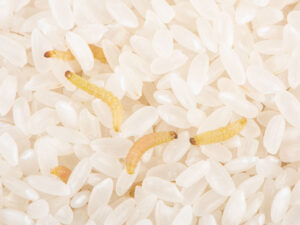
It attacks dried foods, such as flour, rice, cereals, pastas, nuts, grains and animal food. Items that have not been sealed correctly or that have been stored for a long time are especially vulnerable because larvae can pierce cardboard or plastic packaging in order to reach the food products.
Harmful effects
The Indianmeal moth is considered to be a food pest and a parasite. Its larvae cause damage, as they feed directly from the stored foods in which they are developing.
While they are feeding on flour, cereals, rice or nuts, the caterpillars leave behind them various residues like silk threads and digestive waste, which all render the food unfit for consumption.
Because the Indianmeal moth reproduces quickly and its larvae are capable of chewing through cardboard and plastic packaging, an infestation can cause the loss of several items in the same pantry.
In a commercial setting, not only does this lead to significant financial losses, but it also poses a food safety risk. If the presence of Indianmeal moths becomes a public health risk, it can lead to legal proceedings or even a business shutdown.
How to recognize an infestation of Indianmeal moths (Plodia interpunctella)
Here are the most frequent signs to look out for:
- Presence of small, flying butterflies in the kitchen or around cupboards or cabinets, especially in the evening
- Fine, silken threads or webs inside packaging of cereals, flour, rice or other dried goods
- Presence in food products of small, whitish or cream-coloured worms with a brown head
- Black or brownish residue in food products
- Small, cast off empty white skins (moult or exuviae) in storage areas
- Products that seem abnormal upon opening the package, like clumped cereal or unusual texture
- Small cocoons in the corners of cabinets or ceilings
Exterminator tips
“The main challenge with the Indianmeal moth is that the infestation is located directly in the food. As long as the contaminated source is not discovered and eliminated, the problem will persist. Often, it is necessary to discard all the dried foods affected, including pet food and bird seeds, which are a frequent source of contamination. A pest control specialist can help trace back the infestation’s origin and apply a targeted treatment to stop the cycle and prevent the problem from reoccurring.”
Jacques, exterminator at AJS for 30 years.

Prevention and elimination of Indianmeal moths
A problem of Indianmeal moths can spread rapidly if no measures are taken. Here are the most important steps to follow to prevent and eliminate an infestation:
Prevention
- Transfer dried goods into airtight containers.
- Regularly inspect and clean shelves, corners and ledges.
- Avoid leaving bags or pouches of food opened, or keeping dried foods that are aging.
- Vacuum storage areas and around baseboards.
- Inspect new purchases upon arrival (flour, cereals) for signs of contamination.
- Use mite or moth traps to quickly detect their presence.
Elimination
- Inspect all dried goods in the pantry.
- Remove all contaminated items and immediately place them in an outdoor trash bin.
- Vacuum in all corners, cracks and shelving to eliminate eggs and cocoons.
- Empty the vacuum cleaner outdoors.
- Place pheromone traps to attract adult butterflies and slow the rate of reproduction.
Traps don’t resolve the entire problem, but they will help to break the reproductive cycle and detect any remaining adult butterflies.
Because an infestation is located directly in and around food, the use of insecticides is generally limited. The priority therefore lies with eliminating contaminated items and carefully cleaning food storage areas.
Safe handling of infested food
An infested product is considered to be unfit for consumption. So, it’s important not to attempt to sort or clean the affected food, or to try to store contaminated items for pets or for future use.
Any contaminated product should be wrapped in a closed bag, and then discarded.
Treatments to eliminate Indianmeal moths
Intervention by a certified technician can be necessary in order to completely eliminate an infestation of Indianmeal moths.
AJS Extermination first conducts a complete inspection of the premises to identify the sources of the infestation and the contaminated zones. This step helps to target the areas where eggs and larvae can develop.
Depending on the situation, our technicians use methods that are adapted to break the moths’ reproductive cycle and eliminate them at the different stages of their development. The products used are certified and safely applied according to currently applicable norms.
How do I prepare the premises before a treatment?
To ensure the treatment is efficient, we recommend the following:
- Empty cabinets and remove all food from the affected areas.
- Discard contaminated items and thoroughly clean the shelves.
- Vacuum cracks, joints and nooks/corners in the pantry.
- Keep non-infested foods in airtight containers.
- Keep children and pets at a distance during the treatment.
A follow-up may be recommended, depending on the scope of the infestation, to confirm the problem is entirely under control.
Why trust our pest control services?
Choosing an exterminator isn’t something you can do lightly! Offers abound in the extermination sector, but a few important factors should be part of your research before you contact an exterminator: Do they offer a guarantee on their work? Does the company have sufficient experience? Is it possible to talk with a technician to obtain advice on prevention in order to avoid another infestation?
Don’t hesitate to call us — we’ll be glad to explain why thousands of customers value our service!

Outstanding service
Our exterminators perform honest work and provide advice on prevention so as to ensure long-term results.

Advanced technology
Our investment in new technologies ensures we achieve the best results to detect and exterminate insects.

Guaranteed results
We guarantee results of our complete treatments for the extermination of parasites according to the exterminator’s recommendation.

Ecofriendly methods
We always consider using integrated pest management methods (whether mechanical or biological solutions) before opting for methods that use chemicals.