
Even if these ants have an elegant name (Monomorium pharaonis in Latin), their presence inside the homes of humans is far from comforting! How do they differ from carpenter ants, for example? Does their presence in your home pose a risk?
The many varieties of ants in Québec have different behaviours and environments. A good understanding of these aspects is essential to intervene in the best way possible. The following brief guide will help you identify the pharaoh ant and understand its habits. It also provides information about how to eliminate them from your home.
Appearance
The pharaoh ant is small and almost transparent, varying in tones from pale yellow to red or brown. Its abdomen is usually of a darker hue than the rest of its body. The worker measures 1.5 mm to 2.5 mm long, but the queen can measure from 3.5 mm to 5 mm in length and is of a darker brown-red colour compared to the worker. The queen is the only female to have wings. The pharaoh ant’s head is large with typically elbowed antennae that have a club at the end. The pharaoh ant has powerful mandibles or jaws.
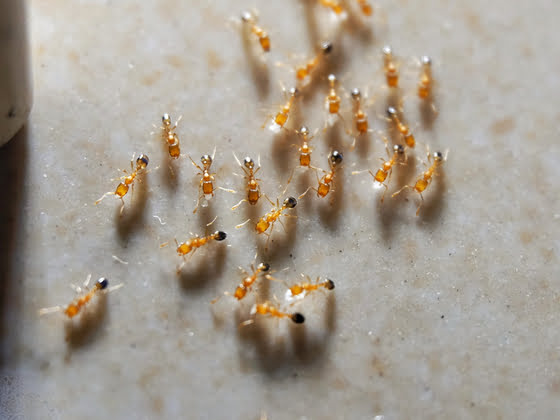
The pharaoh ants’ life cycle
The pharaoh ant queen may lay up to 400 eggs in her lifetime. In ideal conditions, it will take 38 days for a laid egg to mature into an adult worker. Workers have a lifespan of about 70 days, and queens of about 200 days.
Pharaoh ants are difficult to eliminate because they can split their colony into satellite colonies when food or water becomes scarce, or as a reaction to attempts to eradicate them. As a colony counts several queens and males, and mating occurs inside the nest, satellite colonies often keep in contact with the parent colony, especially if they occupy the same building. This is why multiple colonies living near each other might give the impression they are a single, “mega colony”. Such groups can have up to hundreds of thousands of ants.
Habitat and diet
Pharaoh ants are generally considered to have originated from African tropical regions and were introduced in Canada through commerce. In temperate zones, they almost exclusively occupy heated structures. Pharaoh ants usually make their nests in warm and humid areas that are hard to reach, like behind baseboards, slabs or tiles, appliances, and inside furniture. They are typically active at night and are attracted to food sources such as dead insects, meat, cheese and sweet substances like syrup, fruit, jelly, pie and cake.
Harmful effects
Pharaoh ants do not sting, but they can bite. They have become well-known and regular visitors in hotels, motels, commercial bakeries, grocery stores, restaurants, factories, office buildings, hospitals and homes (single-family or multiple-unit dwellings). Once inside, they feed on just about everything humans do.
Pharaoh ants will gather in clumps on food that has been left on a counter or table. They can cause limited structural damage by building their nest behind a wall, between studs, or inside insulation material. They will infest practically any area that offers them easy access to food. They can use electrical wiring and plumbing systems to disperse all over a building or even an entire block. And because they have the ability to move their colonies very quickly, they are particularly hard to eliminate or even control without the help of a pest control professional.
A high presence of pharaoh ants is unpleasant and can also negatively impact the lives of humans in many other ways. For example, they carry and can transmit diseases like salmonella, staphylococcus and clostridium (which causes botulism). While humans in general are rarely at risk, pharaoh ants can transmit these diseases in hospitals or long-term care facilities. Some cases have occurred where pharaoh ants had even infiltrated human wounds in soiled dressing because of their predilection for warm and humid environments.
How do you know if you have a problem with pharaoh ants?
The regular presence of many pharaoh ants passing through the same areas is a sign of infestation. Look out for small ants travelling in single file; they are really following chemical traces left by other ants to show the way from the nest to where the food is. Seeing only one or two ants doesn’t mean there is no risk of infestation, for they multiply very rapidly in optimal conditions.
Exterminator tips
« With pharaoh ants, the challenge is to efficiently control the colony. They will lay their eggs in humid areas inside a building. Because these ants stay in groups, people are sometimes tempted to use a store-bought insecticide that will eliminate some of the ants, but will also cause the colony to split. This will result in even more ants and further worsen the problem. To avoid this, the right kind of bait and appropriate strategy are needed to stop an infestation. »
Jacques, exterminator at AJS for 30 years.

How to prevent or eliminate an infestation of pharaoh ants
Here are a few basic tips that will help you limit the presence of pharaoh ants in your home or place of business:
Preventing an infestation
- Quickly clean and remove any food or refuse spills in eating areas
- Use a rotation system when consuming food from the cupboard: first one in, first one out
- Avoid leaving food crumbs on floors or surfaces where food is prepared
- Make sure waste bins are closed with a well-fitting, watertight lid
Eliminating a colony
Trying to eliminate pharaoh ants yourself will yield practically zero results, except for the ants … they’ll have even more time to multiply, thus multiplying the damage, harmful effects on the occupants, and costs.
Using the services of a pest control professional is often the most efficient and least costly way to eliminate pharaoh ants. Here’s why:
- Pharaoh ants are known for their ability to feel a threat and then splitting their colony in no time. This means they will react to any attempts to spray them with a product seemingly intended to kill them.
- The strategic use of bait remains one of the best ways to eradicate them, but only if the right kind of bait is used! Inappropriate bait will have the same effect as a makeshift spray: the ants will immediately be on alert and prepare to split their colony. A government-certified technician (holding a licence granted by the Québec Ministry of the Environment) has the required knowledge and training to choose the right kind of bait and the winning strategy.
- Locating, controlling and eliminating an infestation of pharaoh ants can take months or up to a year because of the sophisticated networks of nests these ants are able to build. This is why your best defence is calling a licensed exterminator as soon as possible.
Treatment used by AJS Extermination to eliminate pharaoh ants
- The AJS Extermination specialist may set up baiting zones in the home. Baiting zones must not be moved.
- Prior and after the treatment, the use of aerosol insecticides must be avoided in zones frequented by the ants, and these zones must not be cleaned with chemical detergents. These products can reduce the potency of the bait.
- If ants have been seen in the washroom, clean the vanity.
- As it is possible your home may require a global treatment, it must also be thoroughly cleaned, including inside cabinets and drawers.
The presence of pharaoh ants can prove to be very annoying over an extended period, and eradicating a nest can be a challenge for homeowners on the South Shore of Montréal.
Don’t hesitate to contact our exterminators in Longueuil. They’ll be able to help you eliminate pharaoh ants and will provide advice on the best products sold to the public at our store in Greenfield Park, or online.
Frequently asked questions
Do pharaoh ants have a queen?
Yes, even several. Pharaoh ant colonies are polygynous—meaning they can hold dozens, even hundreds of queens at the same time. They mate inside the nest and can lay up to 400 eggs each in the course of their lifetime. During the reproductive process, some of the queens leave the nest with a few workers in order to set up new satellite colonies.
How big are pharaoh ants?
Pharaoh ants are small. The workers are from 1.5 mm to 2.5 mm, and the queens might be up to 5 mm long. Their colour ranges from light yellow to brown, with darker colouring on the abdomen. Their translucid appearance and tiny size make it hard to spot them. This is also what helps them thread their way easily into buildings.
Are pharaoh ants inside the home dangerous?
Most ants do not pose a direct risk to humans. However, the presence of pharaoh ants does constitute a sanitary health risk. They can carry bacteria like salmonella or staphylococcus, thus contaminating kitchen surfaces or food if they circulate in these areas.
What attracts pharaoh ants?
Pharaoh ants are omnivorous—they eat practically anything. They are attracted by heat, humidity, and the presence of food (especially if it contains sugar, fat, or protein). In Québec, as they can’t survive outdoor winter temperatures, they find refuge in heated buildings where they can be active all year. They often settle near electric cables, water drains, baseboards, or behind kitchen appliances, where conditions are favourable to their survival.
Why are pharaoh ants so hard to eliminate?
Pharaoh ant colonies might contain several tens of thousands of individuals, including many queens that continually lay more eggs. When the colony is perturbed, it can split into several satellite colonies (sometimes called “budding”). Thus, a badly thought out or executed attempt at eradication can quickly worsen the problem. In addition, their nests are often in hard-to-reach places. Therefore, completely eliminating pharaoh ants can require several months.
Do spray insecticides work against pharaoh ants?
Spray insecticides don’t work efficiently against pharaoh ants. In fact, these products can even worsen the problem by provoking the colony into “splitting” or “budding” mode. Once the colony has detected a threat, it fragments, and the problem just grows worse. Furthermore, insecticidal sprays only kill visible workers and don’t reach the queens, who continue to lay eggs inside the nest. The most efficient method consists in using bait that the workers bring back to the nest.
Why do pharaoh ants come back even after treatment?
If pharaoh ants return after a treatment, it’s often because it was inadequate and caused the nests to multiply. The queens that were not eliminated by the treatment will continue to lay eggs elsewhere in the building. A new infestation can also come from neighbouring units or common areas of a building where active colonies might still subsist.
Are pharaoh ants active year-round?
Yes, they are active 12 months a year. As they can’t survive outdoors in Québec, they live exclusively inside heated buildings, where they can reproduce and feed non-stop.
How much does it cost to exterminate pharaoh ants?
The average cost of eradicating pharaoh ants is between $400 and $1000. Rates may vary depending on the size of the area that needs to be treated, the quantity of nests and the severity of the infestation.
Why trust our pest control services?
Choosing an exterminator isn’t something you can do lightly! Offers abound in the extermination sector, but a few important factors should be part of your research before you contact an exterminator: Do they offer a guarantee on their work? Does the company have sufficient experience? Is it possible to talk with a technician to obtain advice on prevention in order to avoid another infestation?
Don’t hesitate to call us — we’ll be glad to explain why thousands of customers value our service!

Outstanding service
Our exterminators perform honest work and provide advice on prevention so as to ensure long-term results.

Advanced technology
Our investment in new technologies ensures we achieve the best results to detect and exterminate insects.

Guaranteed results
We guarantee results of our complete treatments for the extermination of parasites according to the exterminator’s recommendation.

Ecofriendly methods
We always consider using integrated pest management methods (whether mechanical or biological solutions) before opting for methods that use chemicals.